It was probably Germany who tested the first nuclear bomb
: history, December 23 2020 ▶
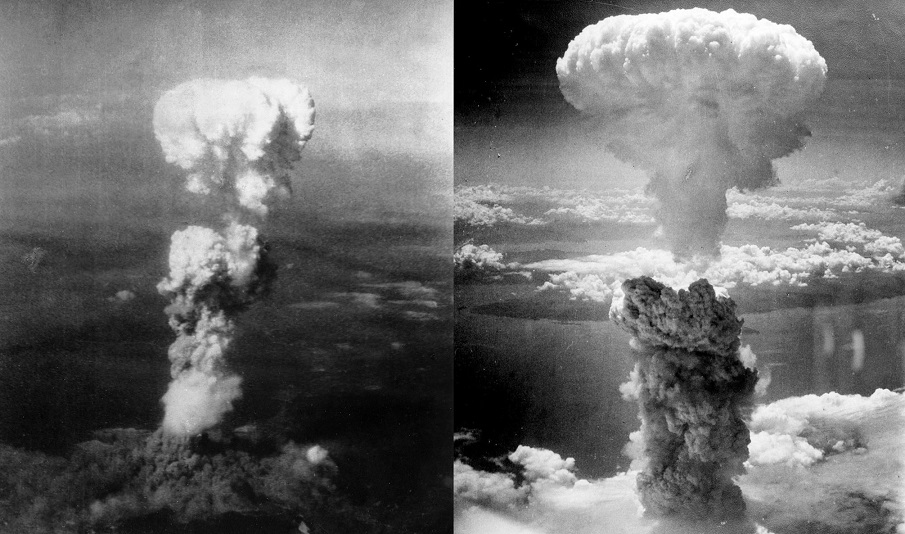
On the picture above - [left] Hiroshima, [right] Nagasaki
The lack of information is also information
Literally hundreds of books and websites have been written on the topic of the first nuclear devices to be used. I believe the vast majority completely miss the point or deliberately hide the truth, that it was not the mighty US to first develop, test and use a nuclear bomb. Maybe it is due to the post-war propaganda, or the general speed of information distribution and accessibility, or because of hiding all documents behind the "top secret" wall, or just the "obey mainstream science" syndrome, but 80 years later we have the opportunity to connect the dots. The following should be taken with a heavy dose of skepticism. I am trying to summarize, in the shortest form possible, what I have found after weeks of digging and comparing different stories. You can check them, if you wish to follow any thread, and you will very quickly realize ... the deeper you go, the more incomplete and wrong the conventional history seems.
I took on this journey, following some information about a little-know SS officer, called Hans Kammler. He is 100% worth a story of his own - he was in charge of logistic operations and particularly advanced weapons. At the end of the war the allies (US) staged his death, in return of information on weapon-development and existing infrastructure.
Unofficial history:
~1 October 1944 around Ludwigslust - Hans Zinsser, a pilot and rocket engineer, flying his Heinkel 111, experiences a nuclear blast nearby. Unfortunately, I could not find the exact date.
Zinsser — submitted as evidence to Allied investigators — reads; "In early October 1944 I flew away 12-15 km from a nuclear test station near Ludwigslust (South of Lübeck)... A cloud shaped like a mushroom with turbulent, billowing sections (at about 7000 meters) stood, without any seeming connections over the spot where the explosion took place. Strong electrical disturbances and the impossibility to continue radio communication as by lighting turned up." A second pilot reportedly observed the same thing an hour later, and an Italian correspondent, who saw the blast, reported his observations to Mussolini. Immediately after the early October 1944 blast, the Reich Propaganda Minister reported in a national broadcast that he had just seen a test of Germany’s latest military technology, "the awesome power of which made me catch my breath and stopped my heartbeat."
Some thoughts: if this was complete nonsense, then why the testimonies have been classified? Back then, there was no technology to create an EMP at that scale (scientists were not even mentioning it until 1950s), except a nuclear device. The statements also come from a tech-savvy person.
12 October 1944, island of Ruegen Luigi Romersa, a personal envoy of Mussolini, observed a German atomic test.
On 12 October 1944, he and a few other men–high-ranking members of the German Army, SS and Nazi Party–were conducted by several physicists to a model village of ordinary dwellings surrounded by tall trees and populated exclusively by sheep. After a cursory inspection, the guests walked about one kilometer away to a concrete bunker fitted with a few, small observation ports of very thick glass. Even so, Romersa and company were instructed to wear darkly tinted goggles for what an official described would be "a test of the disintegration bomb. It is the most powerful explosive that has yet been developed. Nothing can withstand it." A series of warning sirens and flashing, red lights announced the imminent detonation, which occurred as "a sudden, blinding flash" followed by "a thick cloud of smoke" that "took the shape of a column, and then that of a big flower," as a tremor went through the concrete bunker. No one was allowed to leave for several hours, until the lingering effects of the explosion had dissipated."The bomb gives off deathly rays of utmost toxicity," they were told.
Some thoughts: IF this was really written in 1944, the person undoubtedly witnessed a nuclear explosion. There is no other way somebody could depict it in such detail.
4 March 1945, Ohrdruf, Thuringia ("Orhdruf" in some sources, which is wrong). Probably the last and most gruesome test. Witnessed by Russian military spies, who immediately reported to Stalin with "urgent priority" message.
...This occurred at the troop parade ground and barracks at Orhdruf, in south-central Thuringia, when two uranium devices were detonated on 4 March 1945. Both were observed by Soviet spies, who radioed the Kremlin that the Orhdruf explosions produced a "highly radioactive effect." As part of their experiment, the SS officers, who supervised the dual test, confined captured Red Army commissars from the nearby Buchenwald concentration camp to barracks at the center of the blast. "In many cases, their bodies were completely destroyed," according to the spies, who added that such a weapon could "slow down our offensive".
Some thoughts: Russians will never declassify such thing, so finding some real documents will not be possible. You do not report to Stalin, with urgency, that something could slow down HIS offensive - either you are right, or you are dead. Kammler personally supervised the construction of Ohrdruf facility and it was so secret, not only it was not documented, but they even removed the train schedules from the railway lists, so no materials can be traced to it. Some researchers argue, that germans did not have the technology to detonate such device...well, they had a betatron, which potentially might be used for such things. The German historian, Rainer Karlsch, describes it best in his 2005 book "Hitlers Bombe". There are some claims, that Oppenheimer was in Ohrdruf in April 1945 himself. So the top-of-the-top-of-the-most-top-secret weapon's research program, casually flies into a war zone, ...right!?
One may immediately say "well, if there was a nuclear explosion, it surely left some nuclear traces". Sure! The problem is the Ohrdruf area is in a natural preserve, and (more precisely) Jonastal is still considered a military site, so German government prohibits any investigation. "Strangely" the area is known to be the region of Germany with highest concentration of background gamma radiation. Ruegen also has an area (Wittow) which pops-up on the radiation screen. What a coincidence!
All of these tests used uranium-fission(#!) material, as in 1942 German command considered enriching plutonium to be problematic, thus not going further in this direction.
Official history starts here - almost 8 months later:
17 May 1945, the captain of U-234 (heading for Japan), decided to surrender his submarine to the US Navy, and arrived two days later at Portsmouth Navy Yard, New Hampshire. It was carrying ten cases of "uranium oxide" of 560 kilograms weight, and several items which were not included on the Unloading Manifest.
16 July 1945 - Alamogordo Bombing Range - "Trinity" - The test was of an implosion-design plutonium(#!) device.
25 July 1945 - Truman signs the bombing order. Unlike the conventional history, which emphasizes on "saving the lives of the American soldiers", he committed with the sole idea to end the war immediately, in the exact state of the Japanese Empire, before the Russians crush it. A nice starting point for another article indeed!
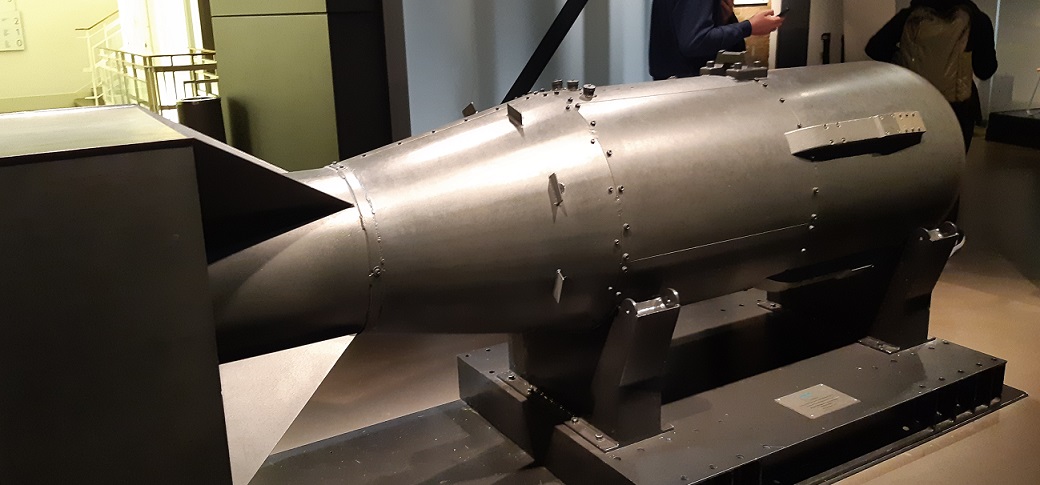
On the picture above - personal archive - "Little Boy" casing in the Imperial War Museum London. I have deliberately left the people's figures in the background so you get a perspective of the size of the bomb.
6 August 1945 - Hiroshima - "Little Boy" - an enriched uranium(#!) gun-type fission weapon. In July 1944, almost all research at Los Alamos was redirected to the implosion-type plutonium(#!) weapon. So...the first combat use of a nuclear weapon, is of one, that had never been tested, you stopped developing it an year ago, and the enrichment facilities suffered numerous setbacks, right!? What if,...just what if, you captured a ready-to-use warhead from your arch-enemy and you want to see how far ahead they really were. Reports claim that "a second Little Boy bomb (using U-235) would not be available until December 1945." The "Little Boy" design also seems better (more compact, easy to manufacture, using existing and proven technologies) than the "Fat Man", pointing to the general German superior technology at the time.
9 August 1945 - Nagasaki - "Fat Man" - plutonium(#!) implosion-type nuclear weapon. Why would you drop another nuke, just 3 days later, unless you have 2 of them, different ones and you do not want some stupid questions on "where do you have the first one from"? Major General Leslie R. Groves Jr. expected to have another "Fat Man" ready for use on August 19, with three more in September and a further three in October...in the meantime, on the very same day, the Russians launched the Manchurian Strategic Offensive, as they knew, the end of the war will follow soon, and they need to seize as much territory as possible.